Written by: Nuno Leiria, Founder & CEO @ Nilo | Last updated: July 11, 2026
Key Takeaways for Aspiring and Already Builders Like You
- Traditional engines like Roblox Studio, Unity, and Unreal expect scripting skills, desktop installs, and complex workflows that slow you down.
- AI-assisted, browser-based tools run in your browser and use natural language prompts for assets and code, so you reach a playable prototype much faster.
- Real-time optimization and integrated AI handle retopology, polygon limits, and multi-tool pipelines, so you stay in flow instead of juggling apps.
- Browser-based platforms make it easy to build together in real time, share with a link, and export to formats like FBX and glTF for Roblox, Unity, and more.
- Nilo combines these pieces in one browser tab, so you can start building and playing without installs or scripting walls.
The Friction You Hit When You Start Building
Four problems often kill your momentum before your project even ships.
Scripting barriers. Roblox Studio uses Lua. Unity uses C#. Unreal Engine uses C++ or Blueprints. Learning any of these from scratch can take months. You probably hit a wall the first time you want something to move, react, or explode.
Desktop installs. Roblox Studio, Unity, and Blender all need downloads, system checks, and setup before you create a single object. A fresh Unity 2D project generates hundreds of megabytes of files before a single sprite is placed.
Retopology. Retopology means cleaning up a 3D mesh so it runs smoothly in a game engine. You reduce polygon count, fix geometry errors, and make sure the model will not lag. AI-generated 3D models frequently have excessive polygon counts that require manual cleanup before they work in a game engine. For Roblox, that usually means decimating to 10k–20k polygons, recalculating normals, and exporting with the right settings. One asset can easily cost you 30 minutes or more.
Multi-tool workflows. A typical Roblox asset pipeline might look like this: generate in Meshy, clean up in Blender, import to Roblox Studio, then debug export errors. Every tool switch breaks your creative flow and adds another interface you have to learn.
Why These Barriers Matter for You
There are 400M+ monthly players on Roblox, 190M+ on Minecraft, and 110M+ on Fortnite. Many of those players, including you, reach a point where playing is not enough and you want to start creating. You already think in 3D from years inside these worlds. What you often lack are tools that match how you think and play.
Most current tools, like Roblox Studio, Unity, Unreal Engine, and Blender, were built for professionals. They were not designed for someone who first learned about polygons while building a house in Minecraft. You end up burning out, dropping projects, and cycling through half-finished ideas for years.
AI-assisted, browser-based creation tools exist to close that gap and meet you where you are.
AI-Assisted, Browser-Based 3D Creation Tools Explained
Traditional desktop engines such as Unity and Unreal Engine need installation, local hardware, and solid technical knowledge before you can build anything interactive. You often add separate tools for modeling, rigging, coding, and publishing, which increases friction even more.
AI-assisted, browser-based creation tools work differently. They run entirely in your browser using technologies like WebAssembly and WebGPU. This is the same kind of shift that let Figma move professional design into the browser. Safari 26 (June 2025) added WebGPU support across macOS, iPadOS, iOS, and visionOS, so high-performance 3D in the browser now works across all major browsers. These tools weave AI into asset generation, coding, and animation, so you spend more time building and less time wrestling with software.
This category sits between big platforms like Roblox Studio and Unity and pure prompt-to-game tools that spit out a full game from one text prompt. Strong browser-based tools keep you inside the world, placing and testing things directly, instead of only describing everything from the outside.
3D Asset Generation and Cleanup Inside Your Browser
The challenge. Building a single game character by hand usually takes a skilled artist many hours of modeling, UV unwrapping, texturing, and rigging. AI tools cut that time a lot. Text-to-3D systems can generate base geometry much faster than manual modeling, but most raw AI outputs still need cleanup before they behave well in a game engine.
Common approaches. Standalone generators like Meshy and Sloyd turn text or image prompts into models. Meshy exports FBX, GLB, OBJ, and other formats that work with Unity, Unreal, and Roblox, but most raw AI-generated assets still require a retopology and optimization pass before use in a shipped game. Sloyd uses parametric templates that usually give you cleaner topology and less cleanup. Both tools still force you to leave the generator and import into a separate engine.
Trade-offs. You trade speed for control. AI generation is fast but often feels like one-shot roulette with limited ways to steer results. Manual modeling gives you full control but takes months to learn. The most helpful workflow combines AI generation with real-time optimization inside the same environment, so you never open Blender just to fix a polycount. This is exactly the approach Nilo takes.
Nilo abstracts multiple AI model providers, including Meshy, Tripo, Nano Banana, Cartwheel, and others, behind one interface. It applies real-time LOD, which means automatic polygon reduction, so assets hit Roblox’s 10k–20k polygon caps without manual cleanup. As one builder noted in Nilo’s February 2026 survey: “I do not have to spend hours on 3D modeling the simplest things. Now I can use Nilo and do it in 15 seconds.”

Natural Language Code Creation You Can Tinker With
The challenge. Scripting often becomes the biggest wall between your game idea and a finished build. You can design a world in your head, but you cannot make it interactive without code.
Common approaches. Vibe coding uses natural language prompts so you create game logic by talking, typing, or even sending images to the AI. A simple browser game can be built in 2–6 hours with AI coding tools, while traditional scripting often took weeks or months for similar first prototypes by beginners. Rosebud AI focuses on code generation in the browser. Replit supports general software development with AI help. GDevelop mixes visual drag-and-drop logic with AI-generated event scripts.
Trade-offs. Pure vibe coding tools generate code but sometimes lack a strong game engine underneath, so the output feels fragile. One small tweak can break something else. Stronger setups give you generated code plus direct access to variables, so you can see and edit what is happening and learn real programming ideas while you build.
Nilo’s built-in code editor accepts natural language in any language, such as English or Spanish, and shows changes in real time inside the 3D world. You can open the code and change variables directly, like switching “speed = 2” to “speed = 20”. This teaches you real programming while skipping the painful starting phase.
Hands-On World Building and Scene Assembly
The challenge. Placing objects, setting up environments, and making a scene feel alive usually means dealing with a complex editor or spending hours on manual configuration.
Common approaches. Roblox Studio offers a powerful scene editor but needs installation and scripting for interactivity. Unity’s scene editor is professional-grade but can overwhelm you on day one. Prompt-to-game tools such as Spawn and Arcade AI generate scenes from text but give you very little direct control after that first generation.
Trade-offs. You balance hands-on control with generation speed. Tools that let you build inside the world, placing, moving, and testing objects in real time, keep you in creative flow. Tools that generate everything from a prompt feel fast at first but often slow you down when you want to iterate.
Nilo uses a radial menu for quick object creation and an inspector panel for detailed tweaks. Physics simulation runs in real time, so everything moves, bumps, and reacts without extra setup. One builder from the February 2026 survey said: “It helps me physically visualize any images I may have drawn and helps make my ideas actually come to life.”
Keeping Your Worlds Fast on Roblox and the Web
The challenge. Roblox enforces strict polygon and texture limits. As mentioned earlier, that usually means 10k–20k polygons and 1024×1024 textures. If you exceed those limits, you get lag, failed imports, or rejected uploads. Handling this by hand feels stressful and technical.
Common approaches. Blender’s Decimate modifier reduces polygon counts, but you need to know the right ratio, often around 0.5–0.7, and the correct export settings. For web use, AI assets usually need aggressive decimation to 5k–20k polygons, texture reduction, and GLB export followed by online compression, which adds 5–15 minutes of manual optimization per model.
Trade-offs. Manual optimization gives you precise control but costs time and Blender knowledge. Automatic optimization is faster but can hurt quality if it is not tuned well.
Nilo’s real-time LOD system adjusts polygon counts on the fly, calibrated for Roblox’s performance needs. You focus on building while the system tracks triangle counts for you.
Building Together in Real Time and Sharing With a Link
The challenge. Game creation has often felt like a solo activity. You build alone, then send a file. Yet the games that made you want to create were multiplayer and social.
Common approaches. Roblox Studio includes team create features, but everyone needs the desktop app installed. PlayCanvas offers a collaborative cloud editor that removes desktop installs and is considered a very production-ready browser-based 3D engine, but it mainly targets professional developers. Many AI-native tools still feel like single-player creation.
Trade-offs. Real-time collaboration needs a strong networking layer. Browser-based tools have a natural advantage because sharing a URL is easier than syncing desktop setups.
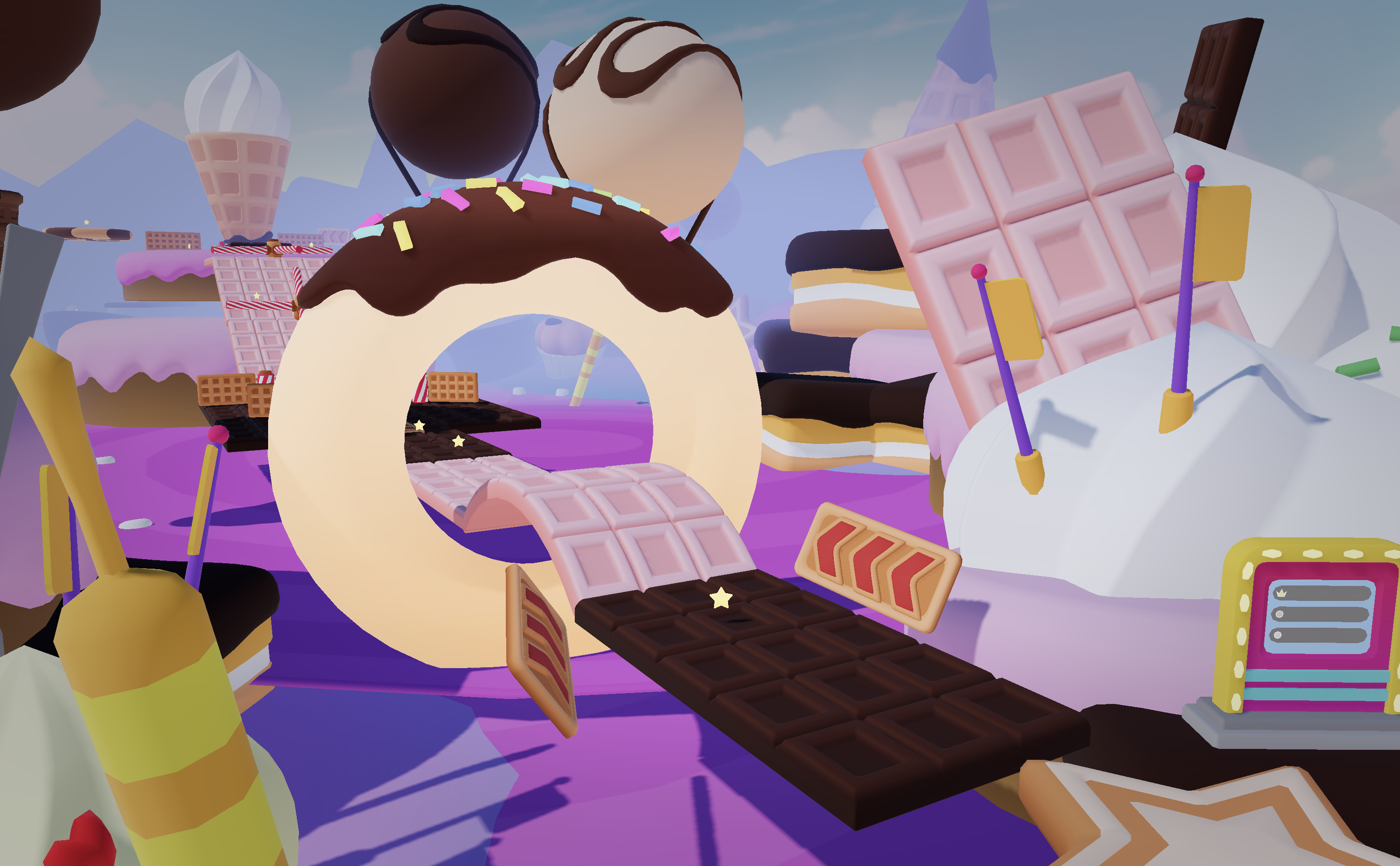
Nilo supports real-time multiplayer creation. You share a link and build together on desktop or mobile, with Discord and Telegram integration. Published worlds are instantly playable through a link, so your friends can join without installing anything.
Exporting Your Creations to Roblox, Unity, and Beyond
The challenge. Your work only matters if you can move it into Roblox, Unity, or Unreal Engine. When exports fail because of wrong scale, missing materials, or broken rigs, you lose time and motivation.
Common approaches. Meshy exports FBX, GLB, OBJ, STL, 3MF, USDZ, and BLEND formats with PBR textures and supports direct import into Unity, Unreal, Godot, and Roblox. Sloyd focuses on clean geometry that reduces retopology work. Most tools still require you to verify scale, materials, and topology after import. Export and pipeline fit matter a lot because a model is useless if it fails to import correctly into the next tool.
Trade-offs. Walled gardens keep you locked into one ecosystem. Open export formats give you freedom but demand more testing. Helpful tools export standard formats and tune their output for specific target platforms.
Nilo exports FBX, OBJ, STL, and glTF, which work with Roblox, Unity, Blender, VRChat, and Unreal Engine. You can treat Nilo as your full creation pipeline or as an asset creation layer that feeds other platforms.
How You Can Evaluate Game Making Software
When you compare tools, look at these six connected areas instead of just counting features.
- Onboarding ease. Aim to create something in your first session without a long tutorial. Time to first playable output matters more than raw feature lists when you start.
- Output quality. Check whether generated assets work in your target platform without heavy cleanup. Export to your engine and inspect scale, materials, and topology.
- Export compatibility. Confirm that the tool exports standard formats such as FBX, GLB, and OBJ. Make sure exports respect the polygon and texture limits of your target platform.
- Performance limits. See whether the tool runs smoothly on your current hardware. Browser-based tools often remove most hardware barriers.
- Collaboration needs. Decide if you want to build alone or with friends. Look for real-time collaboration and simple link sharing if teamwork matters to you.
- Learning value. Choose tools that teach real ideas like rigging, polygons, and physics through the interface instead of hiding everything behind a single “generate” button.
How Nilo, Roblox Studio, Unity, and Rosebud AI Fit Together
Each tool supports different parts of your journey. Nilo combines a real game engine, with C++ physics compiled to WebAssembly and WebGPU graphics, with AI-native asset generation, vibe coding, real-time collaboration, and Roblox-focused export in one browser tab. Roblox Studio gives you deep control for full Roblox game development but expects Lua scripting skills and a desktop install. Unity is a professional standard for cross-platform games and now offers a browser editor that lowers some barriers, but you still need to learn C# and handle a heavier toolset. Rosebud AI focuses on accessible browser-based vibe coding and AI-generated code from prompts, but it does not yet match the custom engine depth or 3D asset pipeline of the other options.
Three Realistic Ways You Might Use These Tools
Scenario 1: You Are a First-Time Creator
You have never touched a game engine. You want to build a world and share it with friends this weekend. Long installs and scripting tutorials feel like a nonstarter.
Start in a browser-based tool. Nilo runs in any browser with no download. You open a link, generate assets from text prompts or sketches, and get working physics and collisions automatically. When your world feels ready, you share it with a link. The same February 2026 survey found that 82% of builders rated their experience as “Awesome” or “Good”, and 93% said they would recommend it to a friend.
Scenario 2: You Focus on Roblox
You already build in Roblox Studio. Your main pain is the asset pipeline. You spend more time in Blender fixing AI-generated meshes than actually designing your world, and Roblox keeps rejecting models for breaking polygon limits.
Use Nilo as your asset creation layer. You generate models, apply real-time LOD optimization to hit Roblox’s polygon caps, rig and animate with one click, then export to Roblox Studio in FBX or GLB format. You keep scripting and publishing inside Roblox Studio. Another builder from the survey said: “Picture yourself, frustrated because you spent the last 5 hours 3D modeling a shipping container. All I have to do is open Nilo and do it in 20 seconds.”
Scenario 3: You Build as a Small Team
You and two friends want to build a game together. Coordinating installs, file versions, and tool access across three people feels painful before you even place a single object.
Browser-based tools remove most of that overhead. In Nilo, you share a link and all three of you build in the same world in real time on desktop or mobile. You avoid installs, file syncing, and waiting for someone to push an update. The same survey reported that 72% of builders say Nilo makes their creative process easier “by a lot”.
Frequently Asked Questions
What game making software works well if I have no coding experience?
The right starting point depends on what you want to build. If you want to create 3D worlds and export to Roblox, a browser-based AI-native tool removes many early barriers. Nilo lets you generate assets, add game logic using natural language, and share your world with a link without writing code. If you plan to dive deep into scripting later, tools like Roblox Studio and Unity are strong long-term choices, but you should expect a steeper learning curve.
Do I need a powerful computer for browser-based game creation?
You do not. Browser-based tools like Nilo run on almost any device, desktop or mobile, without installation or high-end hardware. The engine uses WebAssembly and WebGPU to deliver game-quality performance in the browser, so you do not need a gaming PC to create or play. Traditional desktop engines such as Unity and Unreal Engine still have higher hardware requirements and need installation before you start.
Can I export browser-based creations to Roblox or Unity?
You can, as long as the tool supports standard 3D export formats. Nilo exports FBX, OBJ, STL, and glTF, which work with Roblox Studio, Unity, Unreal Engine, Blender, and VRChat. Nilo also applies automatic LOD optimization so exported assets respect Roblox’s polygon caps mentioned earlier. You should still test exports by importing into your target engine and checking scale, materials, and topology before you finalize an asset.
What is vibe coding, and can it handle real game logic?
Vibe coding means you describe what you want in plain language, by typing, talking, or sending an image to the AI, instead of writing code by hand. It removes the scripting barrier for beginners and speeds up iteration. Quality depends on the engine behind the AI. In Nilo, vibe coding generates working code with real-time feedback in the 3D world. You can open that code and edit variables directly, which helps you learn real programming ideas while you build. Pure prompt-to-game tools may generate code but often lack a strong engine underneath, which makes iteration harder.
How does Nilo differ from prompt-to-game tools like Rosebud AI or Spawn?
Prompt-to-game tools usually generate a full game from a text description and then give you limited control. Nilo behaves like a game engine first. You stand inside a 3D environment, place objects, test physics, collaborate with friends, and iterate in real time. AI acts as your co-pilot instead of replacing you. You generate assets, add logic with natural language, and tweak variables directly. The experience aims to feel like playing a game while you build. Nilo also exports to standard formats for Roblox, Unity, and Unreal Engine, which many prompt-to-game tools do not yet support.
Ready to Start Building Your Own Worlds?
The gap between playing games and making them has never been smaller. Browser technology, AI asset generation, and natural language coding have removed three huge blockers for you: installs, scripting walls, and the Blender grind. Tools that combine these pieces in one place, without forcing you to chain a dozen apps together, are where your creative momentum really grows.
If you want to build your first 3D world, generate Roblox-ready assets without touching Blender, or feel what vibe coding is like inside a real game engine, Nilo is worth a try. It runs in your browser, it is free to start, and your friends can join your world just by clicking a link.