Written by: Nuno Leiria, Founder & CEO @ Nilo | Last updated: July 31, 2026
Key Takeaways
- Traditional 3D game creation tools like Roblox Studio, Unity, and Blender create major barriers through scripting requirements, complex modeling, and fragmented workflows that stop most aspiring builders before they finish their first world.
- AI-assisted browser-based 3D creation tools remove many of these barriers by letting you generate assets, create game logic with natural language prompts, and assemble worlds entirely in the browser without downloads or professional software.
- Evaluate tools based on six core capabilities: whether they handle mesh cleanup automatically, support natural language for game logic, enable real-time collaborative building, manage performance for web delivery, support hands-on world building, and export cleanly to platforms like Roblox and Unity.
- Best practices for adoption include testing ease of onboarding, output quality consistency, export compatibility, performance on mid-range devices, and whether the tool teaches real game development concepts through its interface.
- If you are ready to move from playing to creating without scripting, try Nilo’s open beta to experience browser-based asset generation, vibe coding, and instant sharing.
The Problem: Technical Barriers Stop You Before You Start
Traditional 3D game creation tools like Roblox Studio, Unity, and Blender create major barriers through scripting requirements, complex modeling, and fragmented workflows. You often hit these walls before you finish your first world. That friction makes it hard to stay motivated long enough to ship anything playable.
Why These Barriers Matter for Your Worlds
These barriers do more than slow you down, they stop worlds from getting built. You burn out, drop projects, and cycle through failed attempts. The creative energy that made you want to build in the first place gets buried under technical debt.
The GDC 2026 State of the Game Industry survey found that 52% of game studios now use generative AI in production. That shift is happening at the professional level. For aspiring builders like you, the tools have not fully caught up yet.
Iteration speed matters a lot. The faster you can go from idea to something playable, the more motivated you stay. Long development cycles kill projects. Collaboration gets harder when every teammate needs to install different software and learn separate workflows. If you are not yet committed to a professional toolset, hitting these walls early often means you never come back.
Your ideas deserve better tools. The craft of building 3D worlds is real and worth honoring, and the right tools should make that craft feel like play, not work.
See how Nilo makes 3D creation feel like play in the open beta.
AI-Assisted Browser-Based 3D Creation Tools
A new category of tools has emerged to close this gap. AI-assisted browser-based 3D creation tools let you generate assets, create game logic using natural language prompts (create 3D games by just talking, texting, or even sending images to the AI), assemble worlds, and share them, all without installing desktop software or learning professional-grade applications.
These tools differ from traditional desktop engines like Roblox Studio, Unity, and Unreal Engine in several important ways. They run entirely in your browser, so there is no download, no high-end hardware requirement, and no complex setup. They use AI to handle technical tasks such as mesh generation, rigging, animation, and code that previously required years of training. They also focus on sharing, so you publish a link and anyone can play instantly.
They also differ from pure prompt-to-game tools like Rosebud AI or Arcade AI, which generate a game from a text prompt but give you little control over what comes out. The more capable tools in this category let you build hands-on inside a 3D environment, with AI as your co-pilot rather than your replacement. You get superpowers while still staying in control of your world.
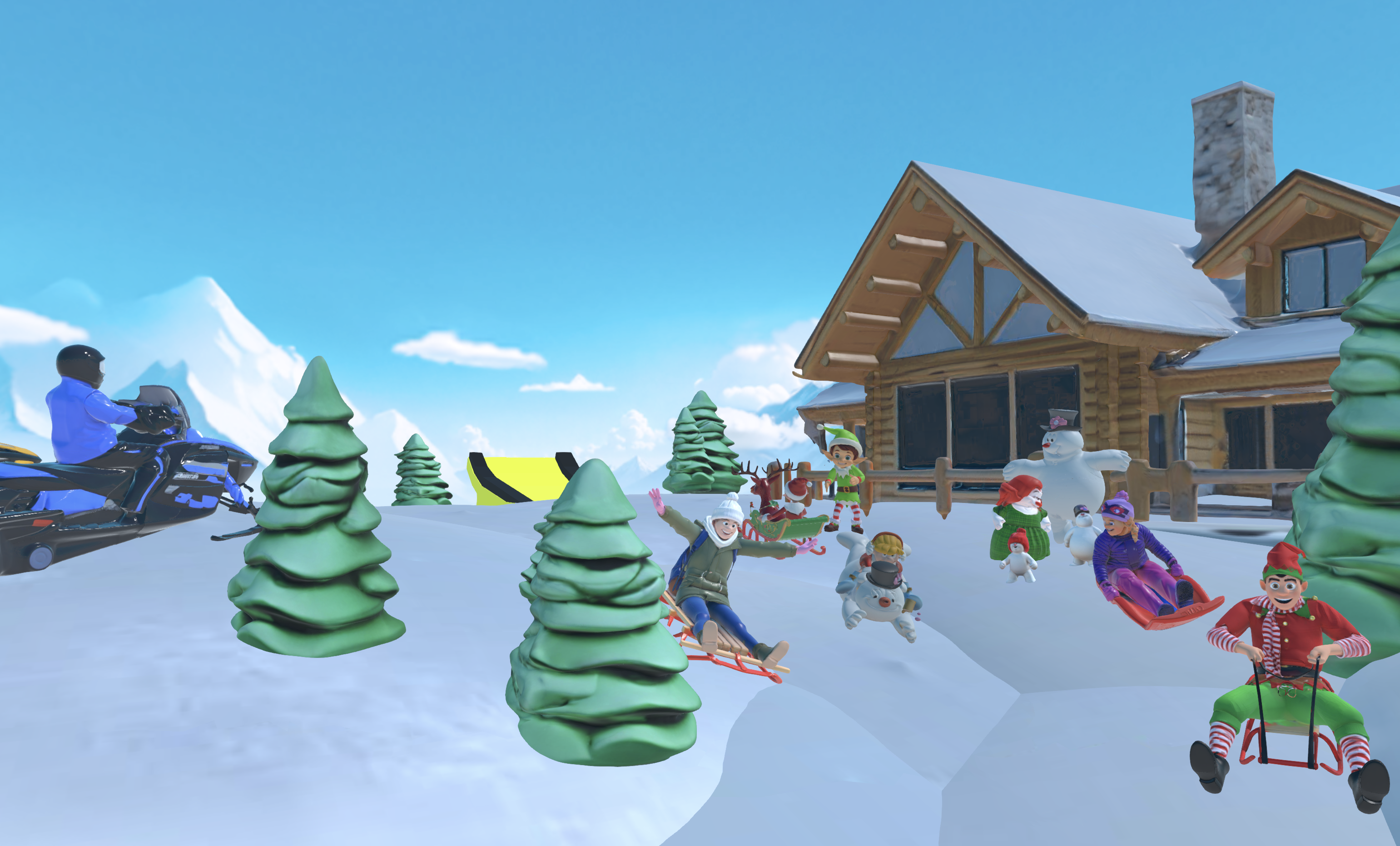
Gartner pegs the low-code development technologies market at roughly $44.5 billion in 2026, growing about 19% a year, which signals that demand for accessible creation tools is accelerating across every category, including games.
Six Capabilities to Check Before You Commit
When you compare AI-assisted browser-based 3D creation tools, six capabilities determine whether a tool will actually help you finish a world or leave you stuck.
3D Asset Generation and Cleanup
The core promise of these tools is generating 3D models such as characters, props, and environments from text prompts or images. The challenge is that AI-generated meshes often feature dense triangle geometry with poor edge flow and non-manifold edges that need cleanup before they work in a game engine.
When you evaluate a tool, look for:
- Whether it handles retopology, the process of cleaning up mesh geometry, automatically or leaves that to you
- Whether it meets platform-specific polygon limits, since Roblox caps assets at 10K–20K polygons
- Whether you can refine outputs through follow-up prompts or sliders instead of regenerating from scratch
- Whether it supports multiple AI model providers so you can switch for better results
Nilo stands out here by abstracting multiple AI providers, including Meshy, Tripo, and others, behind one interface, with a real-time LOD system that automatically adjusts polygon counts. Builders report going from hours to seconds: “I do not have to spend hours on 3D modeling the simplest things. Now I can use Nilo and do it in 15 seconds,” according to Nilo’s February 2026 Survey.

Natural Language Logic Creation
Vibe coding means using natural language, such as typing, talking, or sending images to an AI, to create game logic without writing traditional code. This capability removes the scripting barrier entirely.
Google XR Labs’ research shows that natural language prompts can translate into functional, physics-aware interactive applications in under one minute when the underlying framework is well designed. The key finding is that concrete prompts with clear triggers, such as “make the player jump when I press space,” work reliably, while vague mood-based prompts do not map to specific engine operations.
When you evaluate this capability, check whether the tool shows you real-time feedback in the 3D world as code is generated, whether you can see and tinker with the actual code variables, and whether it supports prompts in languages other than English.
World Building and Scene Assembly
Generating individual assets is one step. Assembling them into a playable world is a different challenge. Look for tools that include procedural world-building features, physics simulation that runs in real time, and intuitive controls for placing and editing objects directly inside the 3D environment.
A 2026 controlled study examined hybrid GUI-LLM interfaces, which combine visual controls with natural language, for 3D scene customization. GUI-first onboarding and prompt-then-refine workflows are the recommended design pattern.

Optimization and Performance Constraints
Performance optimization, such as managing polygon counts, texture sizes, and frame rates, is one of the most stressful parts of traditional game creation. Strong browser-based tools handle much of this automatically.
Ask whether the tool has a built-in LOD system, whether it meets the polygon caps of platforms you want to export to, and whether it runs smoothly on mobile browsers as well as desktop.
Collaboration and Sharing
You probably grew up playing multiplayer games, so your creation tools should support that same energy. Real-time collaborative creation, where you and a friend can build in the same world at the same time, becomes a meaningful differentiator.
PlayCanvas provides real-time collaborative editing where multiple team members can simultaneously modify the same project with changes reflected instantly, similar to Google Docs. Evaluate whether a tool offers this and whether sharing a finished world is as simple as sending a link.
Export and Interoperability
A browser-based tool should not trap your work. Check whether it exports to standard 3D formats such as FBX, OBJ, STL, and glTF, and whether those exports are compatible with Roblox, Unity, Blender, and Unreal Engine. Also check whether exported assets include rigging and animation data or only static meshes.
Test Nilo’s export compatibility in the open beta.
How to Test a Tool Before You Adopt It
Before you commit to any tool, run it through these practical checks based on your situation as a builder.
Ease of onboarding. Start by seeing whether you can get from sign-up to a playable object in under 15 minutes without watching a tutorial. If the answer is no, the tool may not be designed for your workflow. Look for in-app guidance, a radial or quick-access menu for common actions, and AI assistance that responds to plain-language questions.
Output quality. Once you confirm that onboarding feels smooth, generate the same asset two or three times and compare results. Consistent topology, clean textures, and correct proportions matter more than impressive-looking demos. AI-generated 3D models in 2026 often feature jumbled polygons and non-planar geometry that make them unsuitable for animation without human retopology, so check whether the tool handles this automatically.
Export compatibility. After you trust the output quality, export a rigged character and import it into your target platform. Check whether the rig transfers correctly, whether textures survive the export, and whether polygon counts meet platform limits without manual adjustment.
Performance limits. Then build a scene with 20–30 objects and test it on a mid-range device or mobile browser. Frame rate drops and long load times signal that the tool’s engine is not optimized for web delivery.
Collaboration needs. If you want to build with friends, test the real-time collaboration feature before committing. Share a link with a friend and see whether they can join and edit without friction.
Learning value. Finally, check whether the tool teaches real game development concepts such as rigging, polygons, mesh topology, and physics through the interface itself, without forcing you to read long documentation. If a tool hides all the technical details, you may not learn anything transferable. If it exposes them clearly in context, you build real skills while creating.
For aspiring builders or already builders like you who want to move from playing to creating without any scripting, Nilo stands out as a browser-based option that combines asset generation, vibe coding, world building, and one-click export in a single environment. In Nilo’s February 2026 Survey, 93% of builders said they would recommend Nilo to a friend, and 82% rated their experience as “Awesome” or “Good.”
Frequently Asked Questions
What does “vibe coding games” actually mean?
Vibe coding means creating game logic, the rules, behaviors, and interactions that make a game work, by describing what you want in plain language instead of writing traditional code. You type, talk, or send an image to an AI, and it generates working code in real time. You can see the result immediately in your 3D world. People call it “vibe coding” because the process feels intuitive and creative, not technical, and you do not need scripting knowledge to start.
Do I need any coding or modeling skills to use these tools?
No. AI-assisted browser-based 3D creation tools are designed to remove those barriers. You describe what you want through text, voice, or images, and the AI handles the technical execution. The strongest tools also let you see and tinker with the underlying code and mesh settings, so you can learn real concepts like polygon counts, rigging, and physics as you build. You do not need skills to start, and you pick them up naturally as you go.
How is a browser-based tool different from Roblox Studio or Unity?
Roblox Studio and Unity are professional-grade desktop applications. They require installation, often need high-performance hardware, and assume you already know scripting. Browser-based tools run entirely in your browser, with no download, no setup, and no powerful computer required. You can share a link and start building with friends instantly. The trade-off is that browser-based tools may have fewer advanced features than a full desktop engine, although the gap is closing fast as web technology improves.
What are the limits of AI in these tools?
AI generation is fast but not always perfect. Outputs can have inconsistent topology, asymmetry, or unpredictable textures, sometimes called the “AI lottery.” Complex mechanical structures and precise geometric details are harder for AI to get right than organic shapes. The most useful tools let you refine outputs through follow-up prompts, sliders, or manual adjustments instead of forcing you to regenerate from scratch. Concrete, specific prompts such as “a low-poly wooden crate with metal corners” produce more reliable results than vague ones like “make it look cool.”
Can I export what I build to Roblox or other platforms?
That depends on the tool. The strongest options export to standard 3D formats such as FBX, OBJ, STL, and glTF that work with Roblox, Unity, Blender, Unreal Engine, and VRChat. Nilo exports in all of these formats and includes a built-in LOD system that automatically optimizes polygon counts to meet Roblox’s platform limits. Always test an export before you commit to a tool and check that rigging, textures, and geometry survive the transfer intact.
Conclusion: Match the Tool to Your Goals
Traditional 3D game creation forces you to fight technical barriers before you can make anything playable. That friction, including the scripting, modeling complexity, and disconnected workflows discussed earlier, kills projects and burns out builders who have real creative ideas and the motivation to build.
AI-assisted browser-based 3D creation tools change that equation. They handle many technical barriers so you can focus on designing worlds instead of debugging polycounts. The right tool for you depends on what you want to build, whether you need Roblox export compatibility, how much you want to collaborate in real time, and how strongly you care that creation feels like play rather than work.
If you want a browser-based environment where you can generate assets, vibe code game logic, build worlds hands-on, and share instantly, with no scripter needed and no desktop software required, Nilo stands out as a purpose-built option for builders making that move from playing to creating. As one builder put it in Nilo’s February 2026 Survey: “I like how it feels like a good game engine rather than a vibe coding tool, with easy building and a good focus on being able to export and import content.”